



Rabindranath Tagore
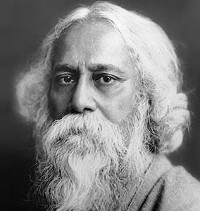
Rabindranath Tagore
In the section of the letters we can highlight his poems and aphorisms, widely known throughout our small world; also his short stories and novels as well as plays.
In the painting section we can say that he was a revolutionary of art as it was known so far in the region where he lived, a fact that he finished modeling with his other skills.
And no less important is the music of Rabindranath, which has its own name as a whole (Rabindra Sangeet), and whose tunes have been adopted by various institutions today that honor and maintain their legacy. Thus, currently the anthem of India and that of Bangladesh are his works. But he composed more than 2,000 musical works. Our western taste partially prevents us from enjoying and understanding Rabindranath's music, so it must be accompanied by musical study and education. About the fact that one of his songs currently forms the anthem of India (Jana Gana Mana), we can say that while we listen to it more than 3,000 years of the weight of the history of India fall over, surprisingly, since this musical theme was composed recently, by Rabindranath himself.
He also stood out as an intellectual influencer of his time, inserted in the debate of public opinion in his country and also internationally. But it is convenient to remember the poet more than for his commented facility to mix with the political dialogue, for his facility to create Art, Art that is part of all us now.